Research Areas
Four thrusts toward intelligent semiconductors you can wear: brain-inspired synaptic devices, rubbery electronics, printing-based micro/nano fabrication, and data-driven process optimization.
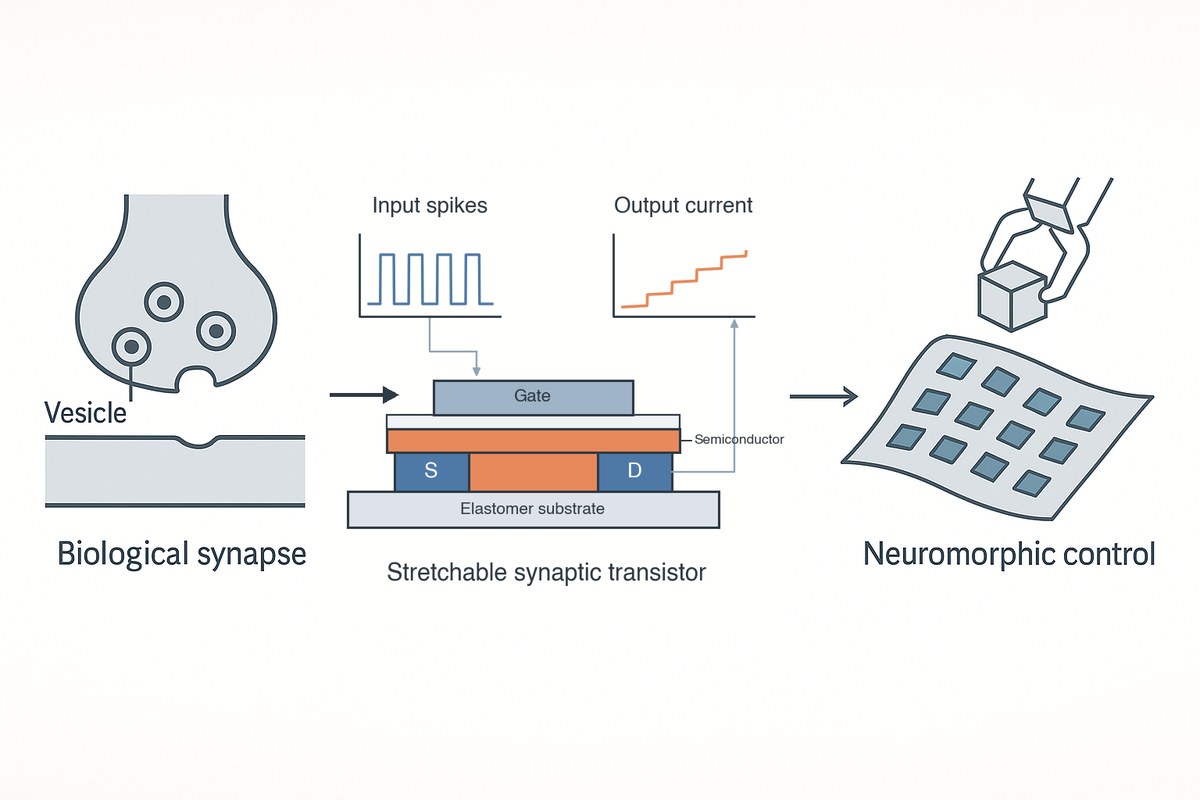
From a biological synapse to a stretchable synaptic transistor: input spikes become remembered conductance, and memory becomes robotic control.뉴런의 언어를 기억하는 소자, 로봇에게 촉각을 가르치다.
Neuromorphic and Synaptic Devices
뇌를 닮은 전자 소자
The brain does not separate sensing, memory, and learning. It performs them together through synapses, with an energy efficiency far beyond conventional processors. LiDM engineers artificial synaptic transistors that reproduce this principle in electronic devices, and pushes them into soft and stretchable forms.
Our biaxially stretchable synaptic transistors and neuromorphic cognitive skins, reported in PNAS and Science Advances, demonstrate how AI hardware can be placed directly on the human body or robotic surfaces. By processing signals where they are sensed, these devices open a path toward skin attachable neuromorphic systems for wearable intelligence, robotic perception, human machine interfaces, and Physical AI.
뇌는 감지, 기억, 학습을 따로 수행하지 않습니다. 시냅스를 통해 이 기능들을 동시에 처리하며, 기존 프로세서가 쉽게 따라가기 어려운 에너지 효율을 보여줍니다. LiDM은 이러한 뇌의 작동 원리를 전자 소자 안에 구현하는 인공 시냅스 트랜지스터를 개발하고, 이를 부드럽고 신축 가능한 형태로 확장합니다.
PNAS와 Science Advances에 보고한 이축 신축성 시냅스 트랜지스터와 뉴로모픽 인지 피부는 AI 하드웨어를 인체 표면과 로봇 표면 위에 직접 구현할 수 있음을 보여준 성과입니다. 신호가 감지되는 바로 그 지점에서 연산이 이루어지는 이 기술은 웨어러블 지능, 로봇 촉각, 인간 기계 인터페이스, Physical AI를 위한 피부 부착형 뉴로모픽 시스템으로 이어집니다.
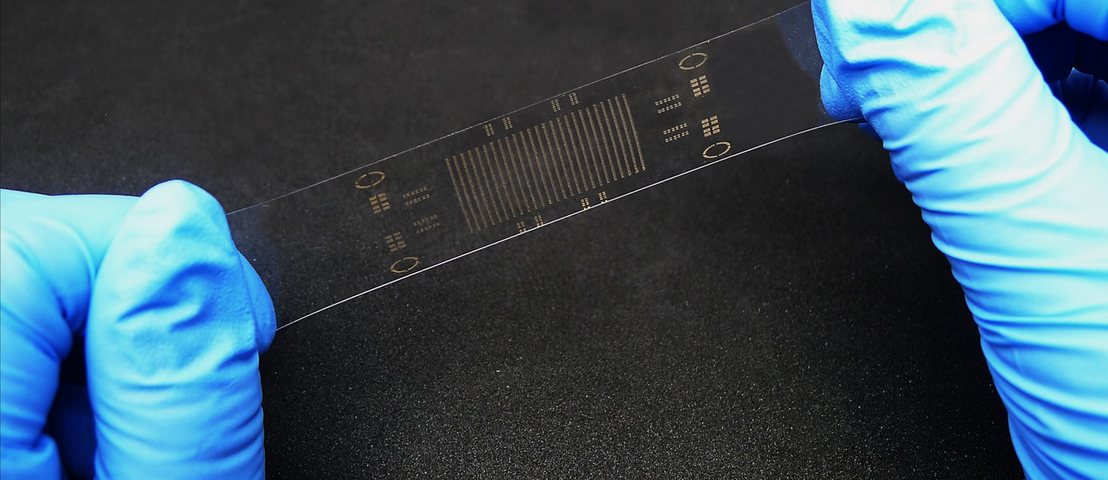
An intrinsically stretchable printed circuit staying functional under strain, fabricated at LiDM.피부처럼 늘어나는 순간에도, 회로는 멈추지 않는다.
Intrinsically Stretchable Electronics
늘어나는 전자회로
Future electronics must move with people, robots, and soft machines. However, most wearable devices still rely on rigid chips packaged inside flexible covers. LiDM takes a more fundamental approach. We design semiconductors, conductors, sensors, and interconnects that are stretchable at the material level, so the circuit itself can deform like skin while maintaining electrical function.
Combined with high resolution patterning and device integration, this approach enables fully stretchable circuits that continue to operate under mechanical strain. These intrinsically stretchable electronics form our core platform for electronic skin, soft robotics, wearable healthcare, next generation human machine interfaces, and body integrated semiconductor systems for Physical AI.
미래의 전자기기는 사람, 로봇, 소프트 머신의 움직임을 따라 함께 변형될 수 있어야 합니다. 그러나 대부분의 웨어러블 전자기기는 여전히 딱딱한 칩을 유연한 외장 안에 넣는 수준에 머물러 있습니다. LiDM은 더 근본적인 접근을 취합니다. 반도체, 전극, 센서, 배선을 재료 수준에서 신축 가능하도록 설계하여, 회로 자체가 피부처럼 늘어나면서도 전기적 기능을 유지하게 만듭니다.
이러한 재료 설계는 고해상도 패터닝과 소자 집적 기술과 결합되어, 잡아당겨지는 동안에도 작동하는 완전 신축형 회로로 구현됩니다. LiDM의 신축성 전자회로는 전자피부, 소프트 로봇, 웨어러블 헬스케어, 차세대 인간 기계 인터페이스, Physical AI를 위한 인체 통합형 반도체 시스템의 핵심 플랫폼입니다.
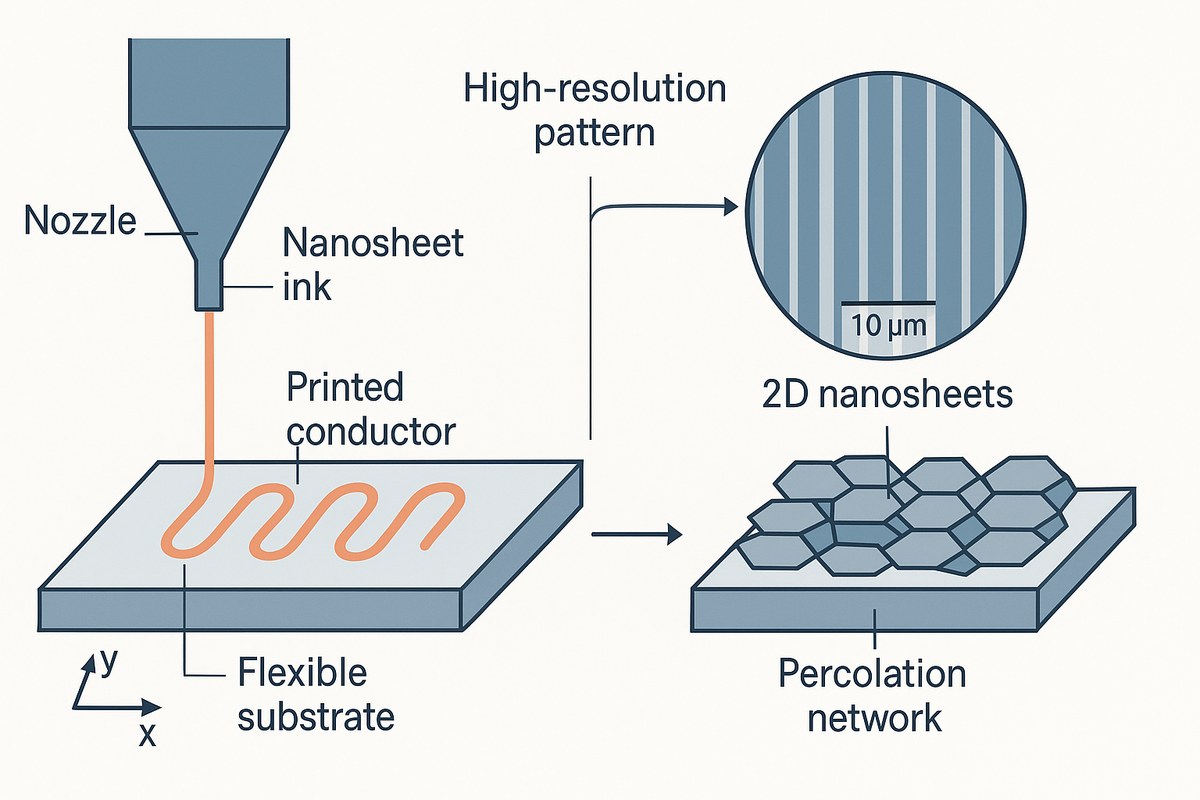
Direct ink writing of 2D nanosheet inks: micrometer-scale conductors printed line by line into percolation networks.나노 잉크 한 줄 한 줄로, 머리카락보다 가는 회로를 그리다.
Micro/Nano Fabrication and Printed Electronics
인쇄로 만드는 미세 전자
New devices require new ways of making them. Soft and stretchable electronics cannot be fully realized by simply adapting conventional microfabrication. LiDM develops manufacturing processes that connect advanced materials to scalable devices, including direct ink writing of rheology engineered two dimensional gold nanosheet inks, fine printed electrodes, and lift off micro patterning for stretchable device arrays.
Our process research also extends to semiconductor packaging. By controlling surface properties, flow behavior, and structural design, we study underfill dynamics in flip chip integration and other packaging relevant processes. This manufacturing perspective links printed electronics, stretchable circuits, sensor arrays, robotic skins, and advanced semiconductor integration.
새로운 소자는 새로운 제조 방식을 요구합니다. 부드럽고 신축 가능한 전자소자는 기존 미세공정을 단순히 적용하는 것만으로는 충분히 구현되기 어렵습니다. LiDM은 첨단 재료를 실제 소자와 대면적 어레이로 연결하는 제조 공정을 개발합니다. 유변학 기반으로 설계한 2차원 금 나노시트 잉크의 직접 잉크 쓰기, 정밀 인쇄 전극, 신축성 소자 어레이를 위한 리프트오프 미세 패터닝이 주요 연구축입니다.
LiDM의 공정 연구는 반도체 패키징 분야로도 확장됩니다. 표면 물성, 유동 거동, 구조 설계를 제어하여 플립칩 접합에서의 언더필 동역학과 패키징 관련 공정을 연구합니다. 이러한 제조 관점은 인쇄전자, 신축성 회로, 센서 어레이, 로봇 피부, 첨단 반도체 집적 기술을 하나의 연구 흐름으로 연결합니다.
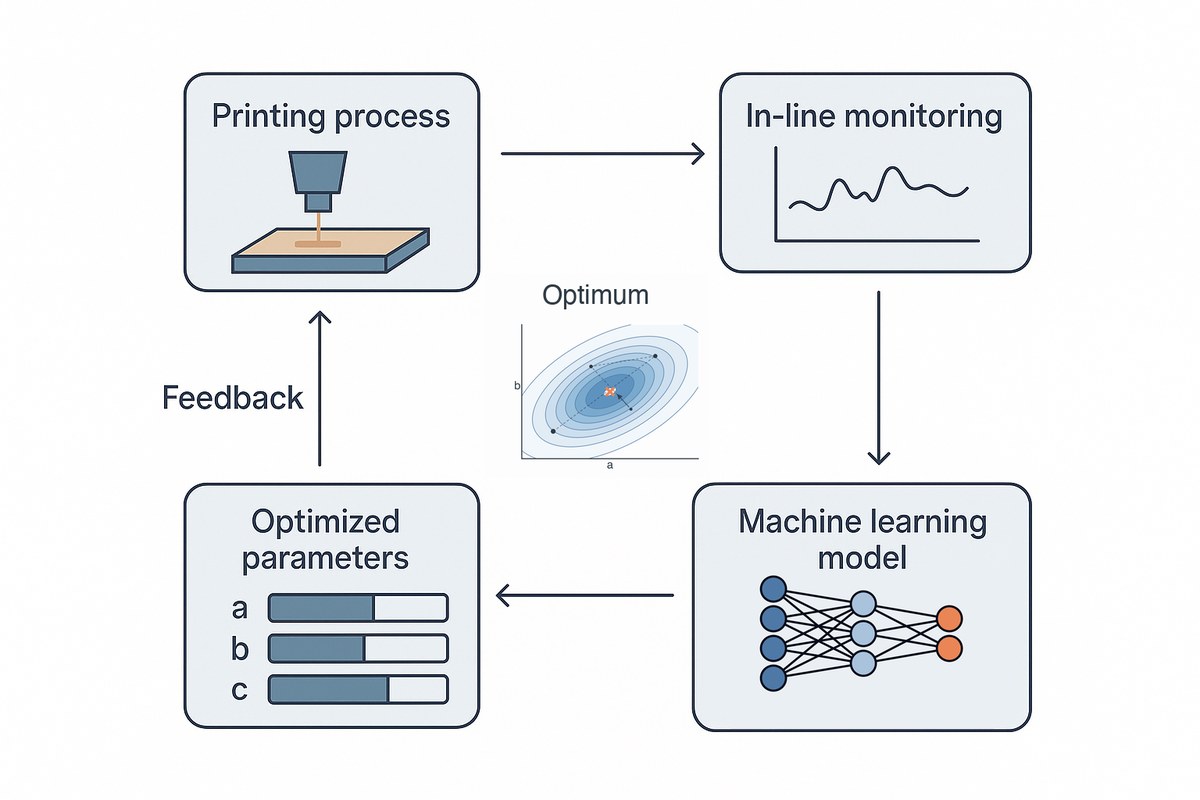
A closed optimization loop: in-line process data trains a model that feeds optimized parameters back to the process.모든 실험은 데이터가 되고, AI는 다음 공정을 더 정교하게 다듬는다.
AI-Driven Process Optimization
스스로 진화하는 공정
In advanced manufacturing, a process recipe is more than a set of parameters. It is accumulated knowledge about materials, structures, machines, and device performance. Printing a reliable device requires the control of many coupled variables, from ink rheology and nozzle motion to drying, pattern formation, and electrical response.
LiDM is building a data driven layer on top of its fabrication lines. We collect process data, connect simulation with experiment, and train machine learning models to identify robust process windows faster than trial and error. This emerging research direction brings together semiconductor manufacturing know how, printed electronics, autonomous optimization, and AI based process design for future scalable devices, robotic systems, and Physical AI hardware.
첨단 제조에서 공정 조건은 단순한 변수의 조합이 아닙니다. 그것은 재료, 구조, 장비, 소자 성능에 대한 축적된 지식입니다. 신뢰성 있는 인쇄 소자를 만들기 위해서는 잉크 유변학, 노즐 운동, 건조 조건, 패턴 형성, 전기적 특성에 이르는 수많은 변수들이 함께 제어되어야 합니다.
LiDM은 제조 공정 위에 데이터 기반 연구 계층을 구축하고 있습니다. 공정 데이터를 체계적으로 축적하고, 시뮬레이션과 실험을 연결하며, 머신러닝 모델을 활용하여 시행착오보다 빠르게 안정적인 공정 조건을 찾아냅니다. 이 신규 연구 방향은 반도체 제조 노하우, 인쇄전자, 자율 공정 최적화, AI 기반 공정 설계를 결합하여 미래의 대면적 소자, 로봇 시스템, Physical AI 하드웨어로 확장됩니다.
Supported By